 Over 5,000 5-Star Ratings on Google!

 559-601-0833
Tankless Water Heater Maintenance Signs: When Your On-Demand Unit Needs Service
Tankless water heaters are marketed as low-maintenance, and that is mostly true. What is not true is that they are no-maintenance. Skip the annual descaling flush for two or three years in Fresno, and the unit that was supposed to last twenty years starts sending warning signs by year seven.
The reason has less to do with the tankless technology and more to do with what is in Fresno’s water. According to the City of Fresno’s 2024 Water Quality Report, total hardness in the municipal supply averages 89.3 milligrams per liter, with detected values ranging as high as 190 mg/L across the distribution system. On the U.S. Geological Survey’s water hardness scale, that means Fresno homes see moderately hard water on average with pockets of very hard water. Rapidly heat that mineral load inside a small heat exchanger, and calcium and magnesium precipitate onto the metal.
The good news is that a well-designed tankless unit will tell you when it needs service. The signs look different from what a traditional tank heater shows, and if you know what to watch for, you can catch scale buildup before it damages the heat exchanger. This guide walks through seven specific warning signs, what proper tankless maintenance actually involves, and how often it should happen in Central Valley water.
Tankless Water Heaters Need Different Maintenance Than Tank Units
Tankless water heater maintenance is not the same job as flushing a traditional tank. The two systems fail from different mechanisms, and the maintenance schedules that keep them healthy address different problems.
A conventional tank water heater stores 40 to 50 gallons of water and heats it continuously. Sediment settles at the bottom of the tank over time and can be flushed out through the drain valve. In a tankless unit, water passes through a narrow heat exchanger and is heated on demand, so there is nothing to settle. Instead, mineral scale bonds directly to the walls of the heat exchanger tubes, where it insulates the metal from the water it is supposed to heat.
That difference changes everything about the maintenance calendar. A tank water heater can go years without a flush and still run, inefficiently but functionally. A tankless heater with heavy scale buildup will not just run less efficiently: it will throw error codes, cycle temperature erratically, and if left long enough, crack the heat exchanger from thermal stress. According to ENERGY STAR, a well-maintained tankless unit lasts around 20 years. Neglected ones rarely reach ten.
Why Fresno’s Water Makes Scale Buildup a Real Problem
Fresno’s municipal water is moderately hard citywide, with parts of the distribution system testing as very hard. That mineral load accelerates scale buildup inside tankless heat exchangers faster than manufacturer maintenance intervals assume.
The City of Fresno’s 2024 Water Quality Report puts average total hardness at 89.3 milligrams per liter, or 5.2 grains per gallon, with a detected range from 65 to 190 mg/L across the system. Per USGS classification, water above 120 mg/L is considered hard and water above 180 mg/L is very hard. Neither reading is unusual for the Central Valley, where groundwater percolates through Sierra Nevada foothill mineral deposits before reaching the tap.
For a tank water heater, that mineral content shortens the anode rod’s life and builds sediment at the bottom. For a tankless heater, the same minerals precipitate onto the heat exchanger tubes every time water flashes to hot. Manufacturer maintenance schedules, typically annual descaling, assume moderately hard water. In parts of Fresno running toward the harder end of the range, that interval is often too generous.
Seven Warning Signs Your Tankless Water Heater Is Overdue For Service
Seven specific warning signs indicate a tankless water heater is behind on maintenance: fluctuating shower temperatures, reduced hot water flow, unusual noises from the unit, error codes on the display, longer wait times for hot water, unexplained utility bill increases, and discolored water at hot taps only.
These signs look different from what a tank heater shows when it is failing. Tank units typically warn you by leaking. Tankless units warn you by protesting: performance drops and diagnostic codes appear long before the heat exchanger cracks.
1. Temperature Fluctuations During a Single Shower
Warm-to-cold-to-warm cycling during one shower is one of the earliest signs of scale buildup on a tankless heat exchanger. Mineral deposits disrupt heat transfer, and the unit’s controller overcorrects trying to hit the set temperature. This symptom is often mistaken for a bad thermostat setting or a pressure balance valve problem in the shower itself.
2. Reduced Hot Water Flow Rate
Scale narrows the passageways inside the heat exchanger, restricting flow. Hot water pressure drops even when cold water pressure at the same fixture is normal. If a bathtub takes noticeably longer to fill than it used to, without any change to the fixtures or the main line, scale is a likely cause.
3. Rumbling, Popping, or Whistling Noises From the Unit
A properly maintained tankless heater is quiet. Rumbling or popping usually means scale is trapping steam bubbles against the heat exchanger surface. Whistling can indicate flow restriction from mineral buildup at the inlet filter or inside the heat exchanger itself.
4. Error Codes on the Display Panel
Nearly every tankless brand has a scale-specific error code. Rinnai displays LC (Lime Condition) when scale is detected in the heat exchanger, and Rinnai’s own documentation warns that damage caused by lime buildup is not covered under warranty. Navien, Noritz, and Rheem each have their own scale-related codes as well. A recurring error code is not a display glitch: it is the unit warning the homeowner before shutdown lockout.
5. Longer Wait Time for Hot Water
Scale buildup insulates the heat exchanger from the water flowing past it. The burner or heating element has to run longer to hit setpoint, which increases the delay between opening a tap and getting hot water. If the kitchen sink used to run hot in five seconds and now takes fifteen, the pipes are not the problem.
6. Higher Gas or Electric Bill Without Changed Usage
Scale acts as insulation between the burner and the water. The unit compensates by running the burner longer and hotter to reach setpoint, which shows up on utility bills. A gradual month-over-month increase without a corresponding change in hot water usage is a real signal.
7. Discolored or Gritty Water at Hot Taps Only
If cold water runs clear but hot water is cloudy, gritty, or has a brownish tint, mineral scale is likely flaking off the heat exchanger. This happens when scale layers get thick enough that pieces break loose during pressure changes. Once discoloration starts, damage is already underway inside the unit.
What Proper Tankless Water Heater Maintenance Actually Involves
Proper tankless water heater maintenance includes annual descaling of the heat exchanger, cleaning the inlet water filter and air intake screen, inspecting the venting and combustion system, and testing the pressure relief valve. This is a different job than flushing a tank heater and requires equipment most homeowners do not own.
The core task is descaling. A licensed plumber isolates the unit from the home’s water supply using the built-in service valves, connects a submersible pump and hoses, and circulates a mild acid solution through the heat exchanger for 45 to 60 minutes to dissolve scale off the internal tubing. Food-grade white vinegar and NSF-approved commercial descalers are both acceptable per Rinnai’s service documentation.
Beyond descaling, a full annual service also covers:
- Inlet water filter cleaning: sediment and debris that would otherwise reach the heat exchanger.
- Air intake screen cleaning: dust that restricts combustion airflow on gas units.
- Venting inspection: checking for blockages, corrosion, or condensate issues at the vent termination.
- Combustion analysis: verifying gas pressure and air-to-fuel ratio on gas units.
- Pressure relief valve test: safety check on a component most people never think about.
How Often A Tankless Water Heater Should Be Serviced In Fresno
Tankless water heaters in Fresno should be professionally serviced every 12 months at minimum, with descaling performed every 6 to 12 months depending on where in the distribution system your home sits and whether you have a whole-house water softener installed upstream.
For homes on the harder end of Fresno’s water range, anywhere the incoming supply tests above about 120 mg/L, twice-yearly descaling is a better fit than annual. For homes with a whole-house water softener treating incoming water before it hits the tankless heater, annual descaling is generally sufficient because the calcium and magnesium have been removed. Skipping maintenance entirely for two or more years is where warranty problems and premature failures start.
Most tankless manufacturers require documented professional maintenance for warranty coverage on the heat exchanger. Rinnai’s service documentation is explicit: damage from lime buildup is not covered under warranty. Missing that documented service history turns a covered repair into a full replacement out of pocket.
Frequently Asked Questions About Tankless Water Heater Maintenance
How much does tankless water heater maintenance cost?
Tankless water heater maintenance cost depends on the scope of the service and the current condition of the unit. A professional annual service that includes descaling, filter cleaning, and combustion inspection is the baseline. Cost varies based on unit accessibility, whether isolation valves are already installed on the water lines, and the severity of existing scale buildup that needs to be dissolved during the flush. A licensed plumber can provide a firm quote once they have inspected the unit.
Can I descale my tankless water heater myself?
Descaling a tankless water heater yourself is possible if the unit has service valves installed and you own a submersible pump, appropriate hoses, and food-grade vinegar. However, most manufacturer warranties require documented professional service to maintain heat exchanger coverage, and a DIY flush skips the venting inspection, combustion analysis, and safety checks that come with a full annual service.
What happens if I never maintain my tankless water heater?
Never maintaining a tankless water heater accelerates scale buildup in the heat exchanger, which reduces efficiency, causes error codes, and eventually cracks the heat exchanger from thermal stress as scale insulates the metal from the water. A neglected tankless unit typically fails within 8 to 12 years instead of reaching its 20-year design life, at which point replacement is usually cheaper than repair.
Does hard water damage tankless water heaters faster than tank heaters?
Hard water damages tankless water heaters faster than tank heaters because minerals precipitate directly onto the heat exchanger’s small internal tubing rather than settling at the bottom of a large tank. Scale bonded to the heat exchanger insulates the metal from the water, forcing the unit to run harder to reach setpoint and shortening its service life. Tank heaters tolerate sediment; tankless heaters do not.
Will a water softener eliminate the need for tankless maintenance?
A water softener significantly reduces scale buildup in a tankless water heater but does not eliminate the need for maintenance entirely. Even with softened water, annual professional service is still required for venting, combustion, filter, and safety checks. The descaling interval, though, can typically stretch to every 18 to 24 months rather than the 6 to 12 months recommended for unsoftened Fresno water.
Getting Ahead of Scale in Fresno’s Water
The homeowners who get the full 20-year lifespan out of a tankless water heater are the ones who treat annual service like a car oil change: not optional, not something to skip for a busy year. In Fresno’s water, that discipline pays off faster than it would in a soft-water city. A single missed descaling can be the difference between a routine service call and a heat exchanger replacement that is not covered under warranty.
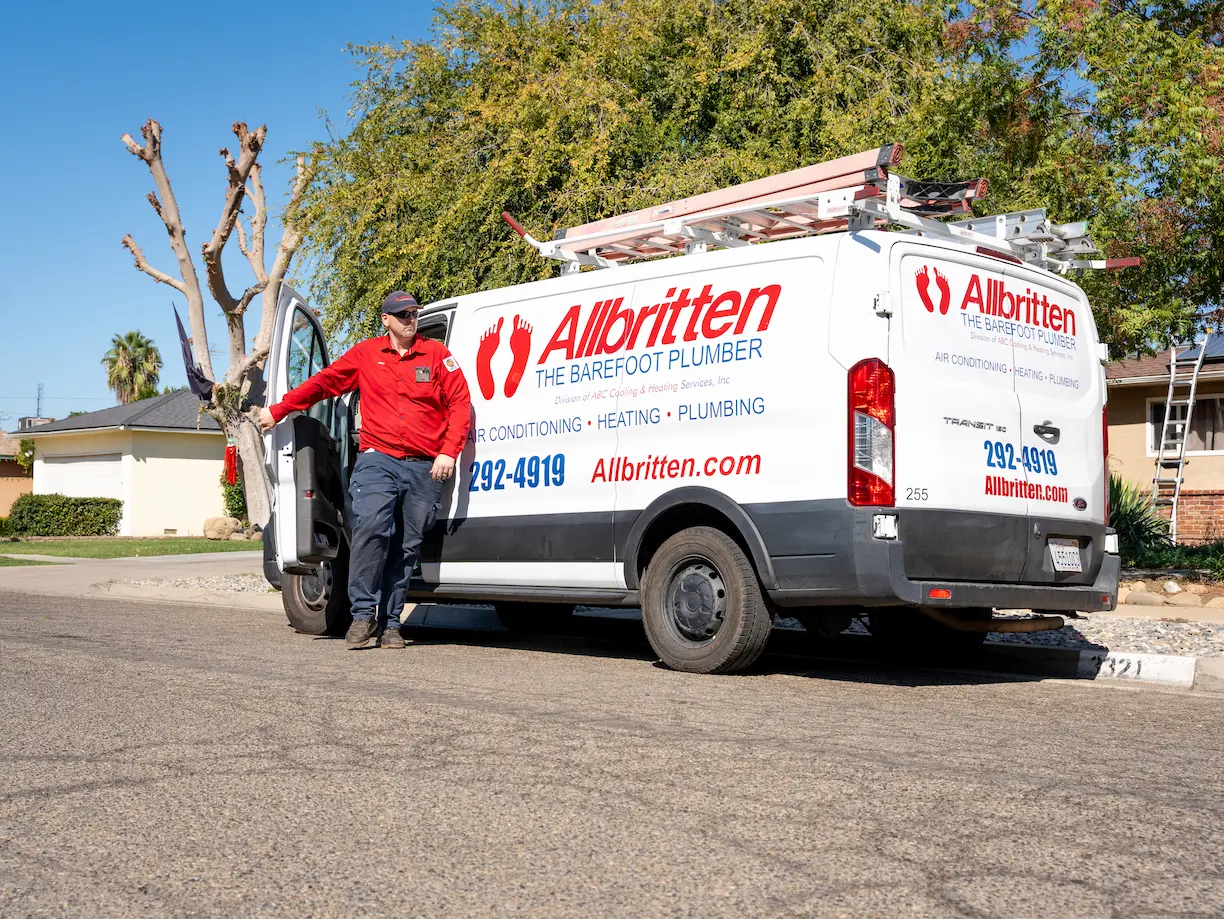
If any of the seven signs above match what a tankless unit at home has been doing, it is time to book service before the error codes turn into a cold shower. Allbritten’s licensed plumbers service every major tankless brand across Fresno and the Central Valley, with documented maintenance records that keep manufacturer warranties intact.
Call 559-601-0833 or schedule a tankless water heater service appointment online.